
Brief History of Computer Science at the Faculty of Mathematics
Computer science and informatics have been studied at the Faculty of Mathematics for more than fifty years – since 1961 (when the present-day Faculty of Mathematics was organized as the Department of Mathematics of the Faculty of Science). The following text gives a brief history of the development of computer science and of the Department of Computer Science at the Faculty of Mathematics (instead of the older names, only the short, current name of the Faculty of Mathematics will be used).
1961: The first informatics course at the Faculty of Mathematics was introduced, under the name Programming and Mathematical Machines. The course covered the Algol-60 language, and later FORTRAN as well. The course was first taught by Professor Vojin Dajović, and then by Professor Konstantin Orlov, until Professor Nedeljko Parezanović came to the Faculty of Mathematics.
1968: An Elliott computer, which used the Autocode language, was available to the teaching staff of the Faculty of Mathematics.
1969: The Computing Center of the Mathematical Institute was opened, headed by Nedeljko Parezanović. The Center was equipped with an IBM 360/44 computer (with a central processor with 64KB of main memory, a punched card reader and punch, and two disk units of 7.5MB each), and it was used both for teaching and for the research work of the staff of the Faculty of Mathematics.

Academician Boris Vladimirovich Gnedenko (USSR) and Prof. Nedeljko Parezanović in front of an analog computer at the Faculty of Mathematics

The IBM 360/44 computer
1969: The Faculty of Mathematics hired its first teacher dedicated solely to teaching computer science – Nedeljko Parezanović. Professor Parezanović then took over the course Programming and Mathematical Machines, and every student was required to write one program in FORTRAN and test it on the IBM 360/44 computer.
1974: A DECLAB 11/40 computer, provided by the Center for Multidisciplinary Studies, was installed at the Faculty of Mathematics. The computer had the following configuration: a central processor with 32KB of main memory, two disk units of 2.4MB each, a laboratory peripheral unit, a graphics display with a light pen, and a dot-matrix printer.
1977: A PDP-11/70 computer, used at that time at universities all over the world and acquired by the Center for Multidisciplinary Studies, was installed at the Faculty of Mathematics. The system had the following configuration: a central unit with 128KB of main memory, a console typewriter, a paper tape reader, a line printer, one disk unit with removable disks of 88MB capacity, one 800/1600BPI magnetic tape unit, and 6 terminals.
1977: Until this year, computer science at the Faculty of Mathematics was studied within three courses: Programming and Mathematical Machines, Introduction to Cybernetics, and Computer Applications. That year, a study group for computer science was formed under the name Mathematics, Informatics and Computer Science with Applications (the "E-track"). This track introduced a number of courses in computer science, including Introduction to Programming, Fundamentals of Computer Systems, Programming Languages and Compilers, Programming Systems, Computer Applications, Biocybernetics, etc. The programming languages studied were Basic, Fortran, Cobol, Pascal, PDP-11 assembly, and machine language.
1977: The Seminar for Computer Science and Informatics was started, and it is still active today. The Seminar was founded and first led by Prof. Nedeljko Parezanović. Its later heads were Prof. Vojislav Stojković, Prof. Gordana Pavlović-Lažetić, Prof. Nenad Mitić, Prof. Miodrag Živković, and Prof. Aleksandar Kartelj.
1980: From this year on, students of the Faculty of Mathematics worked on personal computers such as the Spectrum and the Galaksija.
1982: All study tracks at the Faculty were reformed, and tracks A, B, C, D, E were replaced by tracks labeled M, N, V, R, L. The former "E-track" became the study track named Computer Science and Informatics (the "R-track"), which soon became the most popular track at the Faculty.
1987: From this year on, work was done on the IBM 370/4381 computer located at the Statistical Office of the Republic of Serbia. The first academic network in the SFRY – EARN (European Academic and Research Network, the European branch of BitNet) – was established on that computer, and the Faculty of Mathematics was the first faculty in the then SFRY to obtain e-mail addresses for its teachers and students, giving them the ability to communicate with colleagues abroad. In the same year, the first IBM PC computers arrived at the Faculty of Mathematics.
1987: The Department of Computer Science and Informatics was founded, by separating from the Department of Numerical Mathematics and Programming. Since then, computer science has been treated like the other areas of mathematics that have their own departments at the Faculty of Mathematics. The first head of the Department of Computer Science and Informatics was Prof. Nedeljko Parezanović (in office from 1987 to 1992). At the time the Department was formed, in addition to Professor Parezanović, its members were assistant professors Dr. Vojislav Stojković and Dr. Dušan Tošić, and teaching assistants Gordana Pavlović-Lažetić, M.Sc., Dragan Kolar, M.Sc., Miroslav Martinović, M.Sc., and Miroslav Ristić. In the years that followed, the number of computer science and informatics courses at the Faculty of Mathematics grew, as did the number of members of the Department of Computer Science.
Since the Department was founded, in addition to its former and current teachers, Dušan Bratičević and Milan Tuba have also been members of the Department as teachers. Teachers from the Department of Algebra and Mathematical Logic and the Department of Numerical Mathematics and Optimization (Slaviša Prešić, Marica Prešić, Aleksandar Jovanović, Žarko Mijajlović, Nataša Božović, Milan Božić, Ljubomir Protić) also took part in teaching computer science courses, as did teachers from other faculties of the University of Belgrade and other universities of the former Yugoslavia (Zvonko Damjanović, Suad Alagić, Mihajlo Jauković, Veljko Milutinović).
After Nedeljko Parezanović, the heads of the Department were Dušan Tošić (from 1992 to 1996), Gordana Pavlović-Lažetić (from 1996 to October 2001), Dušan Tošić (from October 2001 to October 2004), Duško Vitas (from October 2004 to December 2007), Miodrag Živković (from December 2007 to February 2014), Predrag Janičić (from February 2014 to February 2017), Vladimir Filipović (from February 2017 to October 2017), Nenad Mitić (from October 2017 to October 2020), Filip Marić (from October 2020 to March 2024), Miroslav Marić (from March 2024 to May 2026), and Milena Vujošević Janičić (since May 2026).
Members of the Department have published a large number of textbooks and problem collections used in teaching, and they successfully publish their research results in leading international journals and at leading conferences. Over the years, a large number of doctoral, master's (magistar), and master theses in computer science and informatics have been defended. The Department of Computer Science and Informatics actively collaborates with other computer science and informatics departments of the University of Belgrade, as well as with a large number of leading IT companies.
1995: The Faculty of Science was reorganized and divided into several faculties, whereby the Faculty of Mathematics became an independent institution, retaining all organizational units of the former Department of Mathematics, including the Department of Computer Science and Informatics.
1996: The Faculty of Mathematics became the first at the University of Belgrade to start awarding the title of Doctor of Computer Science. The first doctoral dissertation in this field, entitled A Functional Interface to Relational Databases and Applications, was defended by Nenad Mitić, under the supervision of Gordana Pavlović-Lažetić.

At the graduation ceremony of the first Doctors of Computer Science (1997)

The Department of Computer Science and Informatics in 1998

One of the computer labs, 1998
2005: A new computer science track named Informatics (the "I-track") was opened, and it soon became the most popular track at the Faculty. Тhe "I" track originally consisted of three years of undergraduate studies and two years of master's studies.
2014: The Faculty of Mathematics was the most sought-after faculty in Serbia – in the June enrollment period, 1019 candidates applied for 395 available places, of whom 672 applied for 221 available places in the computer science tracks (R-track and I-track combined).

The Department of Computer Science and Informatics in 2014.
2015: Interest in studying informatics at the Faculty of Mathematics continued to grow: in the June enrollment period, 380 candidates applied for 120 available places in the I-track. Since this year, the "I" track has the 4+1 format, i.e., consists of four years of undergraduate studies and one year of master's studies.
2015: In the 2014/2015 academic year, the Department had thirty-one members: twelve teachers and nineteen teaching assistants and associates, who covered about sixty courses that year.
Today, the Faculty of Mathematics also has seven classrooms equipped with modern computers and many additional computers used for teaching and research.

The Department of Computer Science and Informatics in 2015.
2016: Interest in studying informatics at the Faculty of Mathematics continues to grow: in the June enrollment period, 556 candidates applied for 120 available places in the I-track. This made the I-track the second most sought-after study program at the University of Belgrade (after psychology), and probably in Serbia as well. There was also great interest in the R-track – about 180 candidates applied.
2016: In the 2016/17 academic year, the Department has 14 teachers and 24 teaching assistants and associates. The Department has 20 female and 18 male members. The average age of the teaching assistants and associates is under 29 years, and the average age of the professors is under 43 years.

The Department of Computer Science and Informatics in 2016.
2018: In the 2018/19 academic year, the Department has 16 teachers and 28 teaching assistants and associates. The Department has 19 female and 25 male members. The average age of the teaching assistants and associates is under 29 years, and the average age of the professors is under 43 years. The Faculty of Mathematics and the Department of Computer Science maintain rich and diverse cooperation with numerous IT companies (professional courses, lectures, internships, scholarships, etc.) and, for the fifth year in a row, are organizing a presentation of IT companies. In addition, the Faculty of Mathematics and the Department of Computer Science and Informatics organize the MATF 2018++ competition for university and high school students in computer science and mathematics.

The Department of Computer Science and Informatics in 2018.

The Department of Computer Science and Informatics in 2019.
2024: Since 2024/25, the Informatics track has followed a new accredited curriculum; the changes to the curriculum were made in response to recent developments in computer science, especially artificial intelligence.
2026: In the 2026/27 academic year, the Department has 22 teachers and 27 teaching assistants and associates. The Department has 19 female and 30 male members. The Faculty of Mathematics and the Department of Computer Science continue to maintain rich and diverse cooperation with numerous IT companies (professional courses, lectures, internships, scholarships, etc.).
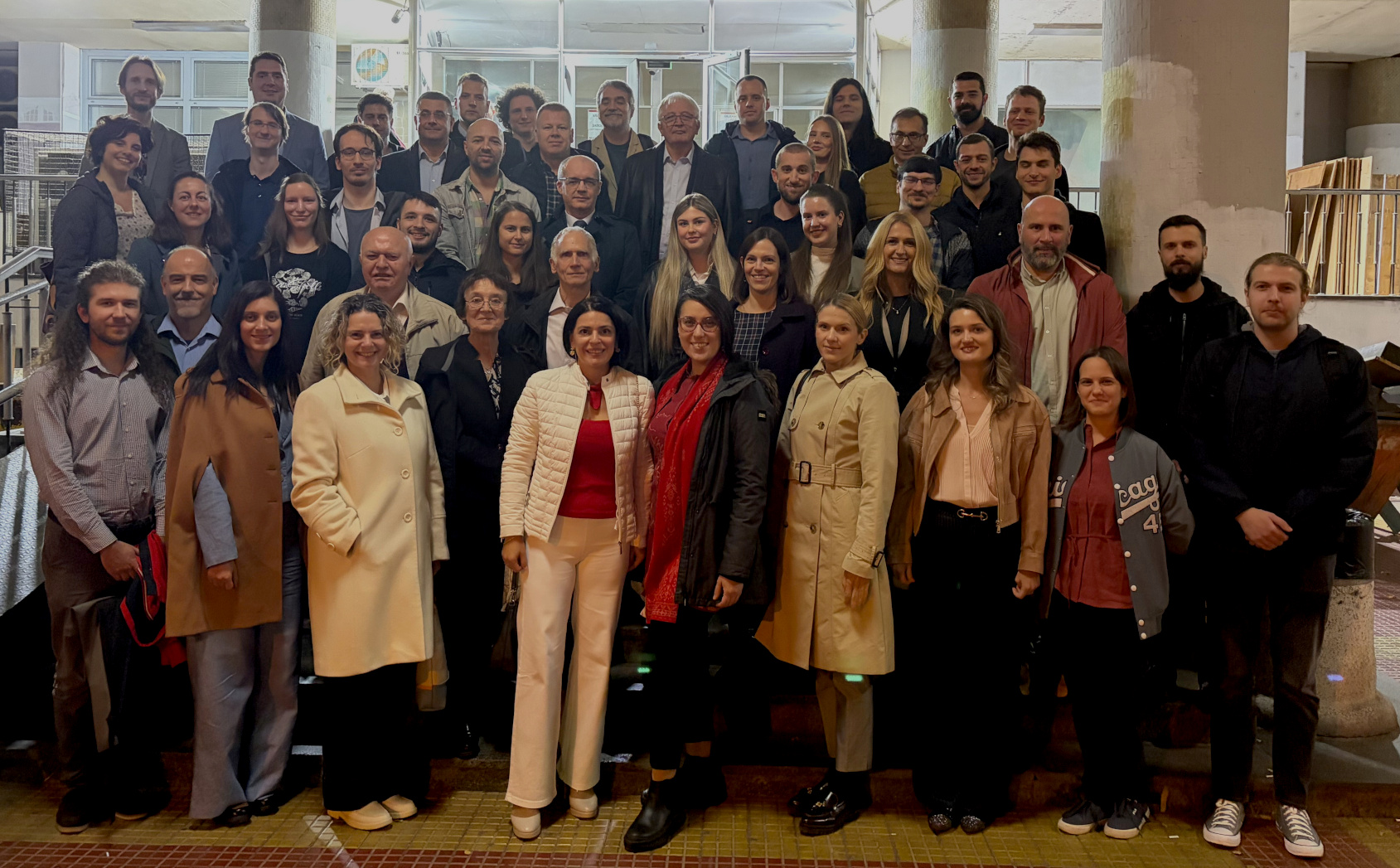
The Department of Computer Science and Informatics in 2026. године.